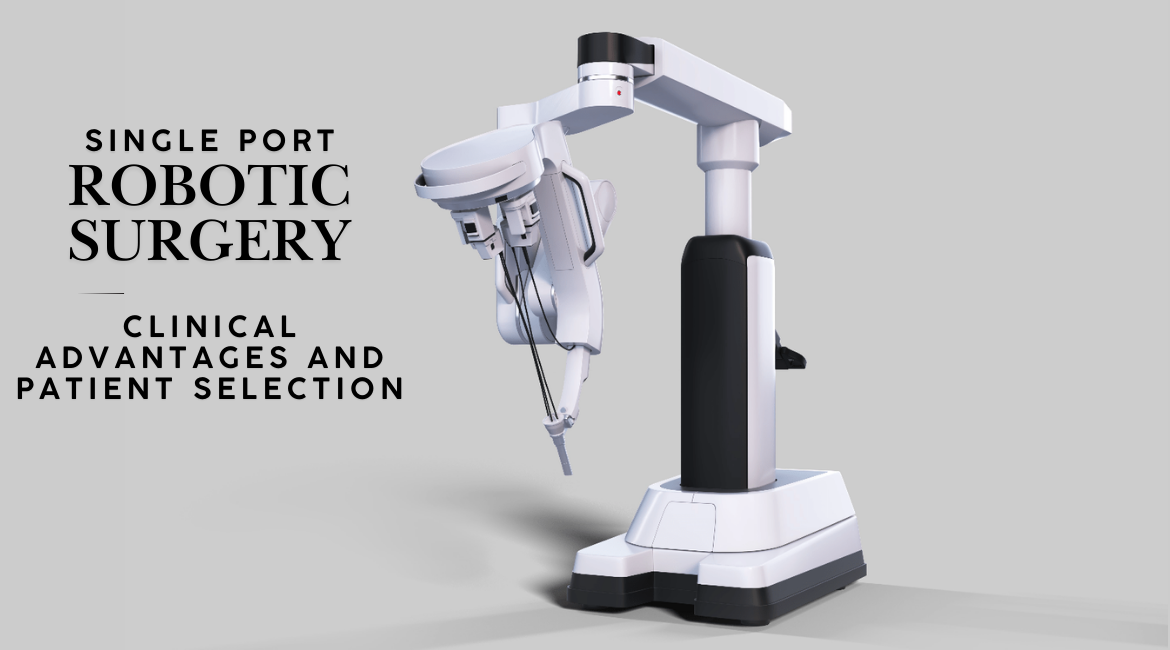
SP Robotic Surgery: Clinical Advantages and Patient Selection
Single Port Robotic Surgery in Urology is reshaping how complex urologic procedures are planned, performed, and experienced by patients. By enabling surgeons to operate through a single incision, this advanced robotic approach minimizes tissue trauma while preserving the precision required for oncologic and reconstructive outcomes. As adoption increases across leading centers, understanding its clinical advantages and ideal patient selection criteria becomes essential for both clinicians and informed patients.
In modern urologic practice, Single Port Robotic Surgery in Urology is no longer an experimental concept. It is an evidence-driven, patient-centered evolution that complements multi-port robotic platforms, particularly in prostate, kidney, and bladder procedures, while opening new pathways for minimally invasive care.
What is Single Port Robotic Surgery in Urology?
Single port robotic surgery refers to performing robotic-assisted procedures through one small incision, typically less than three centimeters, using a flexible cannula that houses multiple articulated instruments and a high-definition 3D camera. Instead of placing several ports across the abdomen, surgeons access the surgical field through a single entry point, allowing internal triangulation once inside the body.
In urology, this approach is especially valuable due to the confined anatomical spaces of the pelvis and retroperitoneum. The technology allows surgeons to maintain dexterity and visualization while significantly reducing the external footprint of surgery.
Why Single Port Matters in Modern Urologic Surgery
Traditional open surgery has largely given way to laparoscopic and multi-port robotic techniques. Single port systems represent the next refinement—focused not just on feasibility, but on patient experience, recovery quality, and anatomical preservation.
Key reasons this approach matters include:
- Reduced surgical trauma with fewer incisions
- Improved cosmetic outcomes
- Lower postoperative pain and analgesic requirements
- Faster mobilization and earlier discharge
- Expanded eligibility for patients previously considered poor candidates for robotic surgery
These advantages align closely with enhanced recovery principles and value-based surgical care models.
Clinical Advantages of SP Robotic Surgery
Reduced Invasiveness Without Compromising Precision
Single port robotic systems use multi-jointed, wristed instruments that articulate within the body, allowing surgeons to operate with precision comparable to multi-port robotics. This internal triangulation enables delicate dissection, suturing, and reconstruction in narrow spaces such as the pelvis.
Improved Postoperative Recovery
By limiting surgery to a single incision, patients often experience:
- Less postoperative pain
- Lower opioid consumption
- Reduced wound-related complications
- Earlier return to daily activities
These benefits are particularly relevant in urologic oncology, where recovery quality directly affects physical and psychological well-being.
Enhanced Access for Complex Anatomy
Single port systems are uniquely suited for:
- Patients with prior abdominal surgeries
- Individuals with dense intra-abdominal adhesions
- Cases requiring retroperitoneal or extraperitoneal access
By avoiding multiple abdominal entry points, surgeons can bypass scarred tissue planes and reduce operative complexity.
Potential for Natural Orifice and Extraperitoneal Surgery
One of the most transformative aspects of single port robotics is its potential use through natural orifices or extraperitoneal pathways. In urology, this includes transvesical and retroperitoneal approaches that reduce peritoneal violation and may further shorten recovery times.
Urologic Procedures Best Suited for Single Port Surgery
While patient selection remains critical, single port robotic surgery has demonstrated strong utility in several urologic procedures:
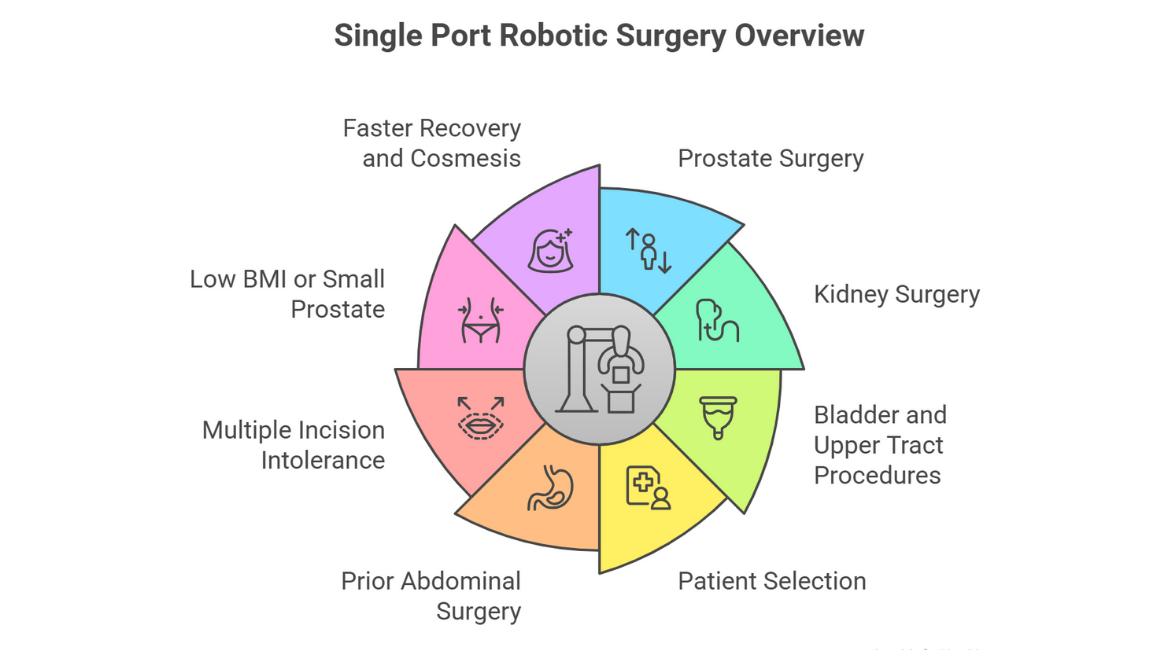
Prostate Surgery
- Radical prostatectomy
- Simple prostatectomy for benign prostatic hyperplasia
The confined pelvic space makes single port systems particularly effective, especially in patients with smaller prostates or lower BMI.
Kidney Surgery
- Partial nephrectomy
- Radical nephrectomy
Retroperitoneal single port access allows surgeons to reach the kidney without traversing the abdominal cavity, minimizing bowel manipulation and postoperative ileus.
Bladder and Upper Tract Procedures
- Selected cystectomy cases
- Pyeloplasty
- Ureteral reimplantation
These procedures benefit from precise reconstruction and reduced external scarring.
Patient Selection: Who Benefits Most?
Careful patient selection is essential to maximize the benefits of single port robotic surgery. Ideal candidates often include:
Patients With Prior Abdominal Surgery
Scar tissue from previous operations can make traditional laparoscopic or multi-port robotic access challenging. Single port systems offer alternative access routes with fewer entry points.
Patients Unable to Tolerate Multiple Incisions
Individuals with certain medical conditions or wound-healing concerns may benefit from minimizing surgical incisions.
Low BMI or Small Prostate Anatomy
In prostate surgery, single port access can be particularly efficient in patients with favorable pelvic anatomy.
Patients Seeking Faster Recovery and Improved Cosmesis
For many patients, reduced scarring and quicker return to normal life are significant considerations, especially when oncologic outcomes are equivalent.
Limitations and Considerations
Despite its advantages, single port robotic surgery is not universally appropriate. Important considerations include:
- Surgeon experience and learning curve
- Availability of specialized robotic platforms
- Case complexity and tumor characteristics
- Patient anatomy and comorbidities
In some complex oncologic cases, multi-port robotics may still offer greater flexibility. The goal is not replacement, but appropriate integration.
Single Port vs Multi-Port Robotic Surgery: A Clinical Perspective
Single port and multi-port robotic systems should be viewed as complementary tools rather than competing technologies.
- Multi-port systems excel in large, multi-quadrant operations and highly complex reconstructions.
- Single port systems shine in anatomically confined spaces and cases prioritizing minimal access and recovery optimization.
Experienced urologic surgeons increasingly select the approach based on procedure type and patient profile, rather than a one-size-fits-all strategy.
Frequently Asked Questions
What is single port robotic surgery in urology?
It is a minimally invasive robotic approach where urologic procedures are performed through a single small incision using articulated instruments and a 3D camera.
Is single port robotic surgery safe?
Yes. When performed by trained surgeons and with appropriate patient selection, outcomes are comparable to multi-port robotic surgery, with added recovery benefits.
Does single port surgery reduce hospital stay?
In many cases, yes. Patients often experience faster mobilization and earlier discharge compared to traditional approaches.
Who is not a good candidate for single port robotic surgery?
Patients with very large tumors, extensive disease requiring multi-quadrant access, or anatomical constraints may benefit more from multi-port or open approaches.
Is single port robotic surgery used for cancer treatment?
Yes. It is increasingly used in prostate, kidney, and selected bladder cancer surgeries, with oncologic outcomes comparable to established robotic techniques.
Does single port surgery cost more?
While the technology is advanced, overall costs may be offset by reduced complications, shorter hospital stays, and faster recovery.
Will single port surgery replace traditional robotic surgery?
No. It is best viewed as an additional option that expands the robotic toolkit, allowing surgeons to tailor the approach to each patient.
The Role of Single Port Robotics in the Future of Urology
Single port robotic surgery represents a shift toward precision-driven minimal access rather than simply fewer incisions. Its true value lies in thoughtful integration—matching the right technology to the right patient at the right time.
As training expands and clinical data continues to grow, Single Port Robotic Surgery in Urology is poised to become a defining element of modern urologic care, particularly in patient-centered oncology and reconstructive surgery pathways.
By combining surgical innovation with individualized care, this approach reinforces a fundamental principle of contemporary urology: better surgery is not just about how we operate, but about how patients heal.